Certifications
Cisco Certified Specialist - Security Core (SCOR 350-701)
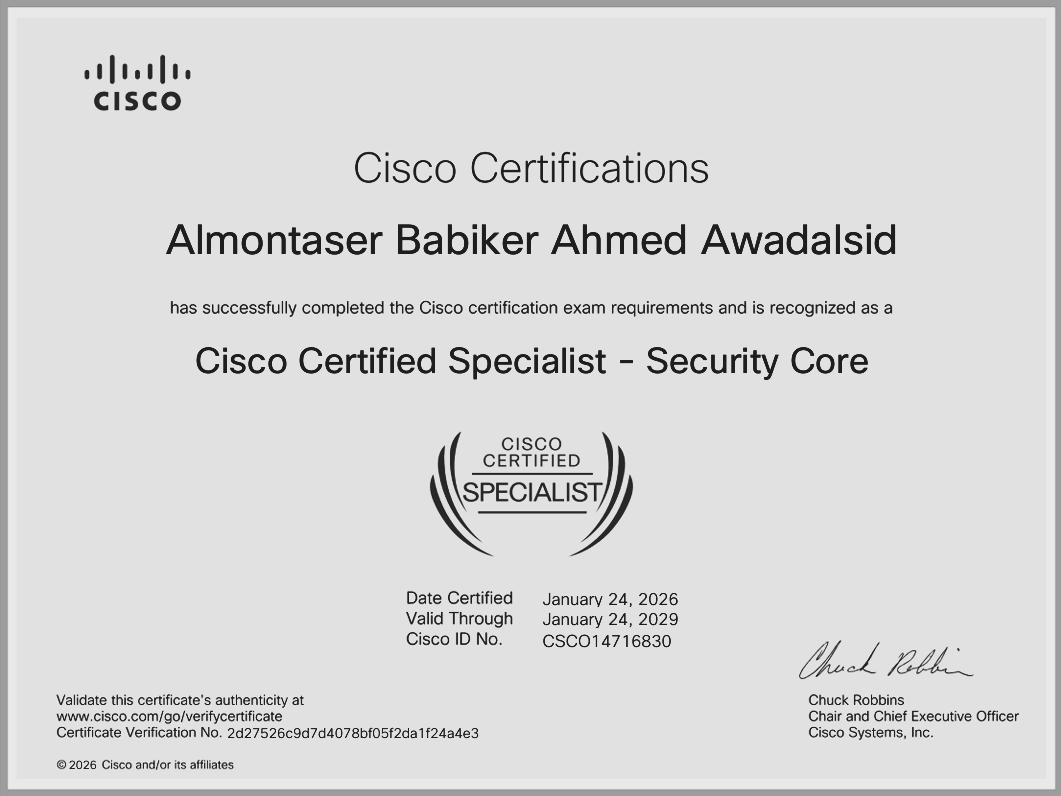
Overview & Key Learnings
This certification validates core expertise in implementing and operating core Cisco security technologies. Through this specialization, I gained deep technical insights into anchoring enterprise networks with robust defense-in-depth methodologies. Key technical areas mastered include:
- Network Security: Implementing secure network architectures, configuring site-to-site and remote access VPNs, and deploying Cisco Firepower Next-Generation Firewalls (NGFW).
- Cloud Security: Securing multi-cloud environments utilizing tools like Cisco Umbrella and securing cloud applications (SaaS/IaaS).
- Content Security: Configuring web and email security appliances (WSA/ESA) to mitigate modern threat vectors.
- Endpoint & Identity: Implementing secure endpoint connectivity, zero-trust endpoint protection (AMP for Endpoints), and contextual network access control via Cisco Identity Services Engine (ISE).
Cisco Certified Network Associate (CCNA 200-301)
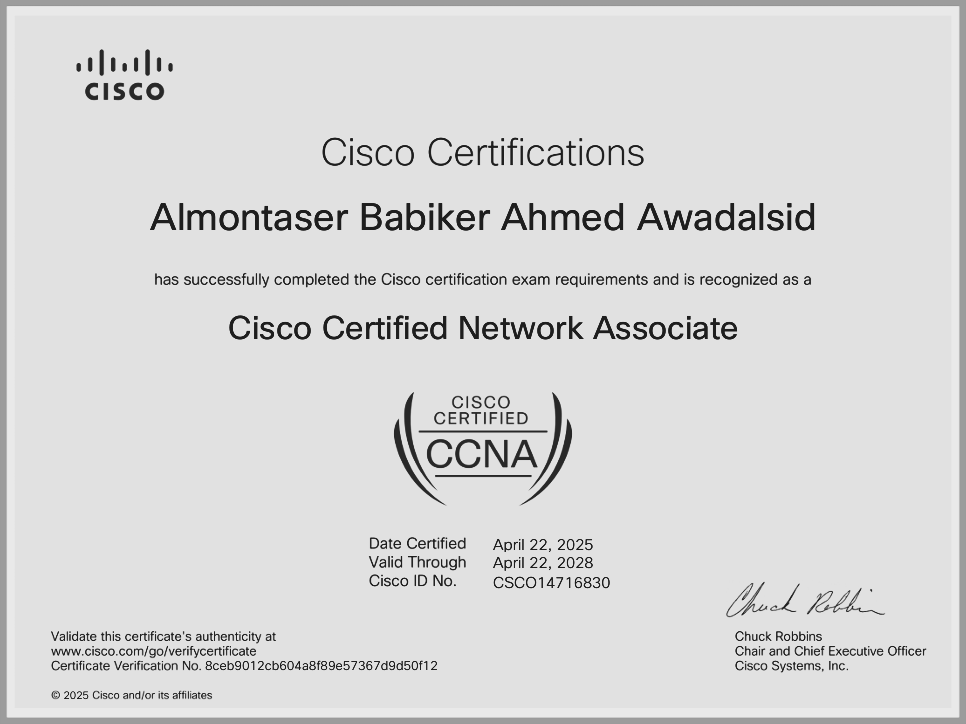
Overview & Key Learnings
This certification serves as the baseline foundation for enterprise engineering, validating a comprehensive understanding of core networking architectures, protocols, and modern infrastructure services. Through this designation, I mastered the fundamental building blocks of routing, switching, and operational network administration. Key technical areas mastered include:
- Network Access & Infrastructure: Configuring, verifying, and troubleshooting VLANs, trunking mechanisms (802.1Q), EtherChannel bundling (LACP), and STP topologies (Rapid PVST+) to guarantee Layer 2 redundancy and loop-free access layers.
- IP Connectivity & Routing: Implementing static routing architectures and dynamic single-area OSPFv2, alongside interpreting routing tables to map out predictable next-hop forwarding pathways.
- IP Services: Deploying essential network components including dynamic address allocation (DHCP client/relay), translation architectures (NAT/PAT), domain resolution (DNS), time synchronization (NTP), and initial Quality of Service (QoS) classification traffic markers.
- Automation & Programmability: Shifting from traditional command-line interfaces to software-defined patterns, utilizing REST APIs, JSON data structures, and understanding the core operations of controller-based campus fabrics (Cisco DNA Center).
Huawei Certified ICT Associate - Routing & Switching (HCIA-R&S)
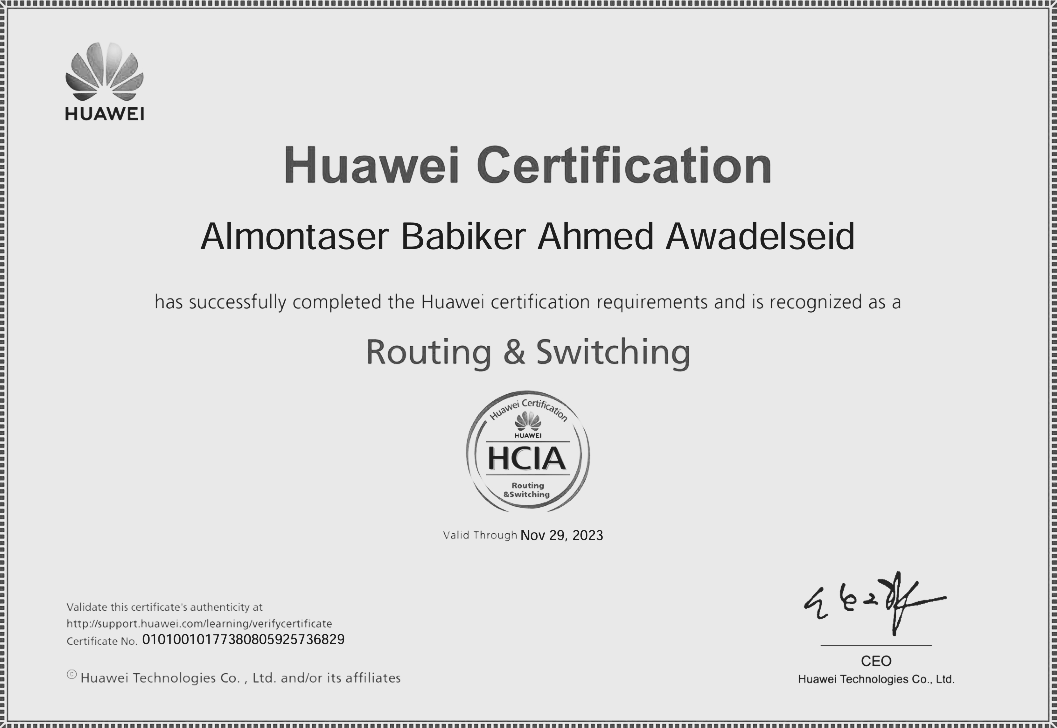
Overview & Key Learnings
This certification validates core competencies in small-to-medium enterprise data communication networks. Through this path, I mastered the operation, deployment, and optimization of Huawei routing and switching hardware while navigating the Versatile Routing Platform (VRP) operating system. Key technical areas mastered include:
- VRP Operating System Basics: Developing a strong command of Huawei’s proprietary CLI structure, user view configurations, and system file systems to systematically handle baseline network device administration.
- LAN Technologies & Ethernet Switching: Implementing access-layer switching principles, configuring local VLAN architectures, and deploying Spanning Tree Protocols (STP/RSTP) alongside Link Aggregation (Eth-Trunk) to build high-availability, loop-free campus networks.
- IP Routing Operations: Establishing predictable packet delivery systems using a combination of foundational static routing parameters and single-area Open Shortest Path First (OSPF) dynamic routing tables within a VRP ecosystem.
- Network Infrastructure Security & Services: Hardening device control planes via Access Control Lists (ACL) and Access, Authentication, and Accounting (AAA) controls, while provisioning baseline enterprise edge services like Network Address Translation (NAT) and dynamic IP addressing (DHCP).